What the record doesn’t show
What we checked on the DFL side, what we could not confirm, and why any of it matters.
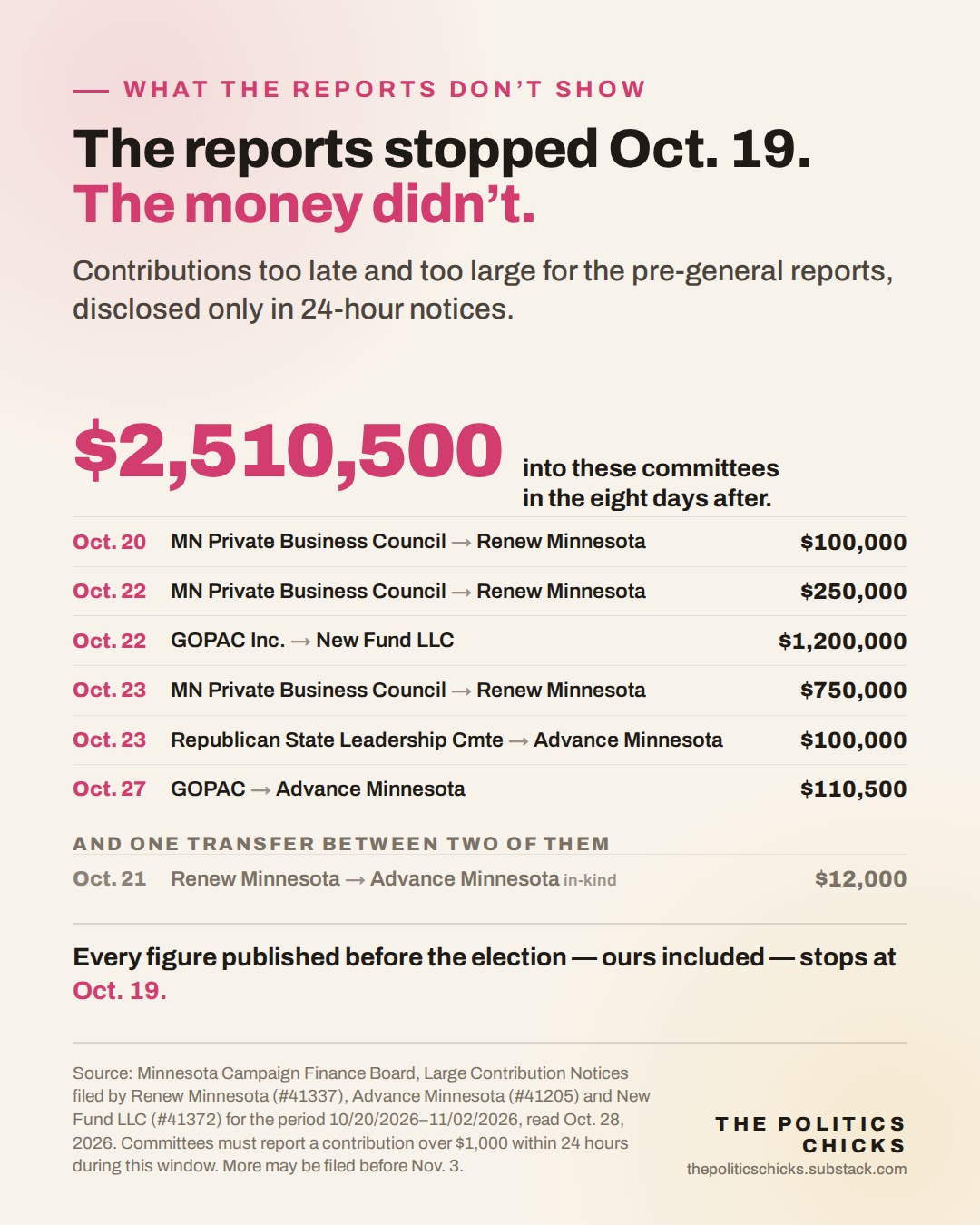
The reports stopped on Oct. 19. The money didn’t.
Everything above comes from public filings. This is what those filings leave out.
Minnesota’s pre-general reports close on Oct. 19. A contribution over $1,000 that arrives after that — in the last two weeks, when the ads run hardest — is disclosed in a separate 24-hour notice instead. Those notices are the only public record of money raised in the final stretch. We pulled every one of them on Oct. 28.
In the eight days after the cutoff, $2,510,500 more came into this network.
Oct. 20, 22 and 23. The Minnesota Private Business Council sent Renew $100,000, then $250,000, then $750,000 — $1,100,000 in four days.
Oct. 22. GOPAC Inc. sent New Fund LLC $1,200,000, about 60 percent of everything New Fund raised in all of 2024.
Oct. 23. The Republican State Leadership Committee sent Advance Minnesota $100,000.
Oct. 27. GOPAC sent Advance Minnesota $110,500, a week before the election.
And on Oct. 21, Renew sent Advance Minnesota $12,000 worth of text messages, reported as an in-kind contribution. It is not the first money to move directly from Renew to the committee that has spent $227,590 against Janigo: Renew gave Advance $22,500 in cash across three payments in 2025, on April 9 and twice on Nov. 20. The Oct. 21 text buy is the first of 2026.
Advance is not funded only from out of state: through the Oct. 19 cutoff GOPAC had given it $1,015,000 and the Republican State Leadership Committee $1,525,000, and Pro Jobs Majority, the Minnesota Chamber of Commerce’s political fund, gave another $850,000. All told, committees have reported spending $1,141,308 against Janigo this year and $117,633 supporting her, led by the DFL State Central Committee at $76,657: nearly ten dollars against her for every one spent on her behalf, counting independent expenditures only and not either campaign’s own spending.
That brings GOPAC’s 2026 total to these three committees to $9,400,500, under three names: “GOPAC Election Fund” to Renew, “GOPAC” to Advance Minnesota, “GOPAC Inc.” to New Fund. The filings don’t say whether those names are one organization or three; they share an Arlington address, and GOPAC Election Fund named GOPAC Inc. as its source on its June and July statements. GOPAC money goes elsewhere in Minnesota too: its federal reports show $980,000 to the Republican Party of Minnesota on Sept. 18.
Which raises the question the filings are supposed to answer: where does GOPAC’s money come from?
When an association gives more than $5,000 in a calendar year to Minnesota independent expenditure committees, state law requires it to tell the recipient committee’s treasurer where the money came from. The form is Schedule A1, “Source of Funding for Contribution.” It asks for every donor of more than $5,000 by name and address, and for one more number: the total attributable to everyone too small to name.
GOPAC Election Fund filled in that schedule in some form five times in 2026 — April, June, July, August and September.
On its two October statements, for $1,200,000 on Oct. 6 and $200,000 on Oct. 16, Schedule A1 is blank. No names. Line A blank, Line B blank, Line C blank. The only entry is the figure on the line that reads “TOTAL AMOUNT OF CONTRIBUTION (Line A + Line B + Line C)” — a sum of three empty boxes. Both were signed by a GOPAC officer. The October 16 statement also leaves the responsible officer’s name, email and phone number blank.
Other donors’ statements filed with the same report were complete. The Minnesota Private Business Council reported $100,000 on Line B — the total from donors too small to itemize, which names no one. GOPAC used Line B the same way in August and September: those forms are filled in, but they name no one either. What makes the two October statements different is that nothing was filled in at all. Common Sense America Election Fund itemized its $150,000 on Line A.
And the five GOPAC did fill in are worth reading. On the April, June and July statements, the only source named is GOPAC Inc. — its own parent organization, at the same Arlington address. The form asks who gave GOPAC the money. GOPAC’s answer was GOPAC.
Nothing here required anyone to break a law. That’s the problem.
A voter in a swing district this fall may hear from Renew Minnesota, Minnesotans for Justice, Empower Minnesota, Build Minnesota and First Principles PAC. Nothing on those ads tells them that one man chairs four of those five committees. Or that three of every four dollars behind the biggest one came from Virginia this year. Or that some of the same donors also fund the Senate Republican caucus’s attacks in the same races. Or that the outlet amplifying the attacks has been funded and written for by people inside the same circle.
When Renew passes money to Empower, Empower’s reports list one donor: Renew Minnesota. The names behind Renew drop off. When Minnesotans for Justice sends money to Nashville, the trail runs through a federal filing most voters will never open.
It doesn’t have to work that way. In 2022, Arizona voters approved a law requiring groups that spend above set thresholds on campaign advertising to name the original sources of that money, even when it passes through middlemen. The law has been challenged in state and federal court and upheld so far.
Until then, it falls to the people willing to read the filings. We’re still reading. We’ll update this site as new filings post.
Renew Minnesota, Mitchell Williamson and Alpha News are welcome to respond to anything here. We’ll add any response.